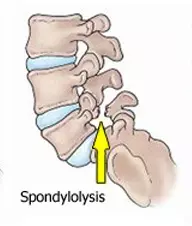
Last week I sat down with a surgeon and went over an image of my spine. He pointed out a fracture in my L5 vertebra, specifically the pars interarticularis. The condition is known as pars defect or spondylolisys. We spent about 45 minutes together as he explained the condition and answered my questions. Finally, after experiencing back pain since last fall, I had some answers!
The surgeon explained fusion surgery as an an option. He estimated a 95% success rate. Fusion surgery would involve slicing my back open while under general anesthesia and then inserting titanium screws into the affected vertebra. After the screws are inserted, I’d stay in the hospital for a couple days for monitoring. Then full recovery would be expected to take two to three months.
The fusion puts stress on the vertebrae above it. Thus, with each year that goes by there is a 1% increase in the probability that vertebrae above the affected area would require surgery. Also, there is always a chance that there is a failure with the connection between the screws and the bone, which would necessitate surgery to correct that.
The surgeon did not think physical therapy would be effective in mitigating the condition. On the bright side, he explained that my pars defect was not a condition that had to be treated. I would not cripple myself by continuing various physical activities. I could do whatever I wanted to do, it would just be a matter of if I could tolerate the pain, he explained.
We discussed pain management including a wearing a back brace or seeing a pain specialist who can do various things involving sticking needles into my back. Also we discussed minimizing pain triggering activities.
In my case, more acute pain is triggered by load on the back, jostling the back, and flexion movements of the back. So forget about squats, jogging, and many types of abdominal exercises. Practicing full speed pop-ups on land also will have to be limited.
Fortunately, moderate extensions actually alleviate the pain because the fractured bone segments are not pressing on each other. That is excellent news for surfing because much of the time is spent paddling out with the back arched. My pop ups in the water are not that quick, and the water absorbs some of the shock, so I’ve never had a back issue with pop ups in the water like I do on land.
So while I’m in the desert, I’ll be walking, and while I’m near the ocean, I’ll be surfing (and walking). I don’t need surgery to do those things. As to running, it was useful while it lasted and and provided for some good times. I’m looking into a stationary recumbent bike as a back friendly replacement for the Zone 3 – 5 cardio that running formerly provided. I can still lift weights; I just need to be selective in the exercises I choose. I also ordered a Rogue Nylon Lifting Belt (Made in USA) to see if that helps with certain exercises.
We’ll see how it goes!
With Love,
P. Gustav Mueller, author of The Present